
Transforming Sri Lankan Industries Through Digital Twin Technology
By Dr. Kasun Subasinghage
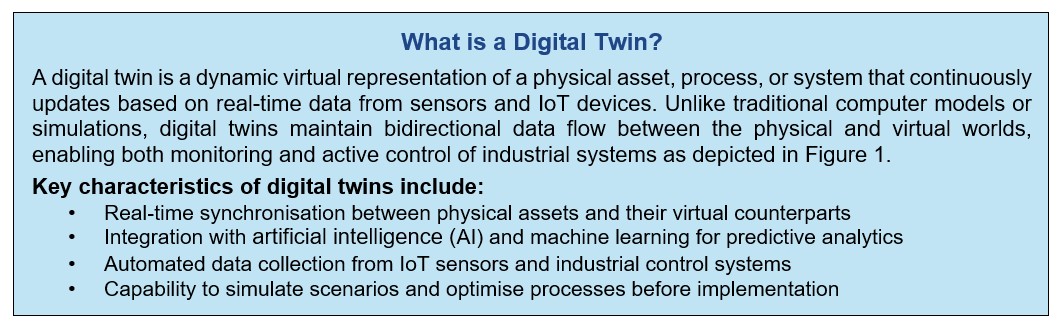
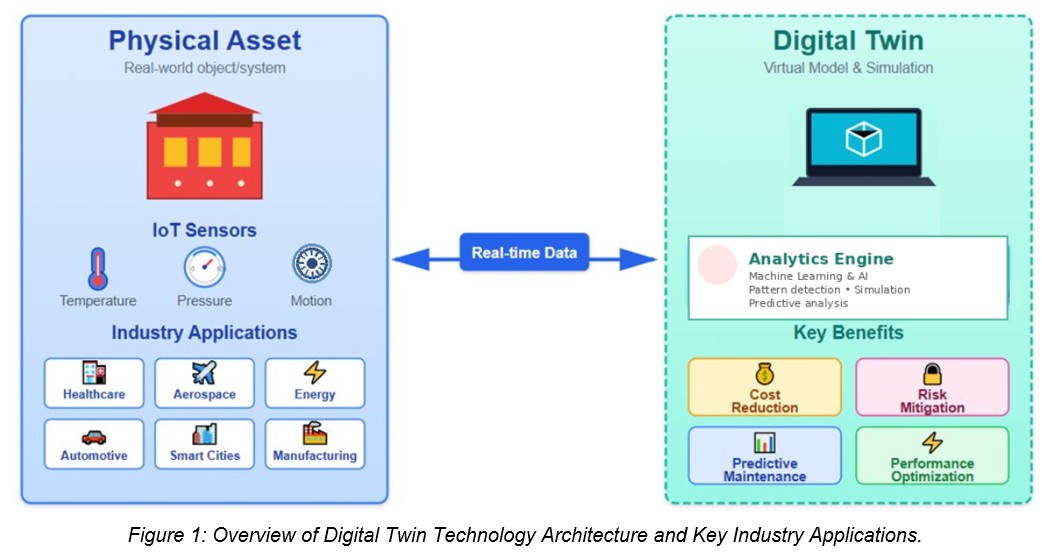
Technology Enablers and Current Capabilities
Powered by AI, cloud computing, and big data analytics, digital twin technology is revolutionising industries globally. The market has surged from USD 20.19 billion in 2024 to a projected USD 396.19 billion by 2033, representing a 39.2% compound annual growth rate [1].
Leading manufacturers demonstrate tangible benefits: Siemens’ Amberg plant achieved 75% productivity increase with near-zero defects [2]; Tesla’s Gigafactory improved battery production efficiency by 30% [2]; BMW reduced defects by 30% while accelerating development cycles by two years [3]. Beyond manufacturing, healthcare uses digital twins for personalised treatment plans, smart cities optimise urban planning (University of Florida’s virtual Jacksonville model), and buildings reduce carbon emissions by 50%. Modern platforms integrate IoT sensors (72% adoption), cloud computing (84%), and Augmented Reality (AR)/ Virtual Reality (VR) (26%) [4]. Strategic partnerships like Siemens-NVIDIA enable AI models running 25 times faster, enhancing smart factory operations.
Digital Twins in Developing Economies
While developed nations lead digital twin adoption, developing countries face unique opportunities. Sensor costs have declined significantly since 2010 [5], cloud platforms are widely available, and AI tools are democratised, significantly lowering entry barriers. Thailand, Vietnam, and Malaysia are already implementing digital twins in manufacturing and utilities, proving that advanced infrastructure isn’t a prerequisite; strategic planning suffices.
For developing nations, digital twins offer leapfrog opportunities to bypass legacy systems and adopt cutting-edge solutions directly. Technology addresses critical challenges: enhancing competitiveness, optimising limited resources, improving export quality, and building supply chain resilience. However, success requires adapting global best practices to local contexts, creatively addressing infrastructure gaps, and building indigenous capabilities rather than remaining vendor dependent.
Applications Across Sri Lankan Industries
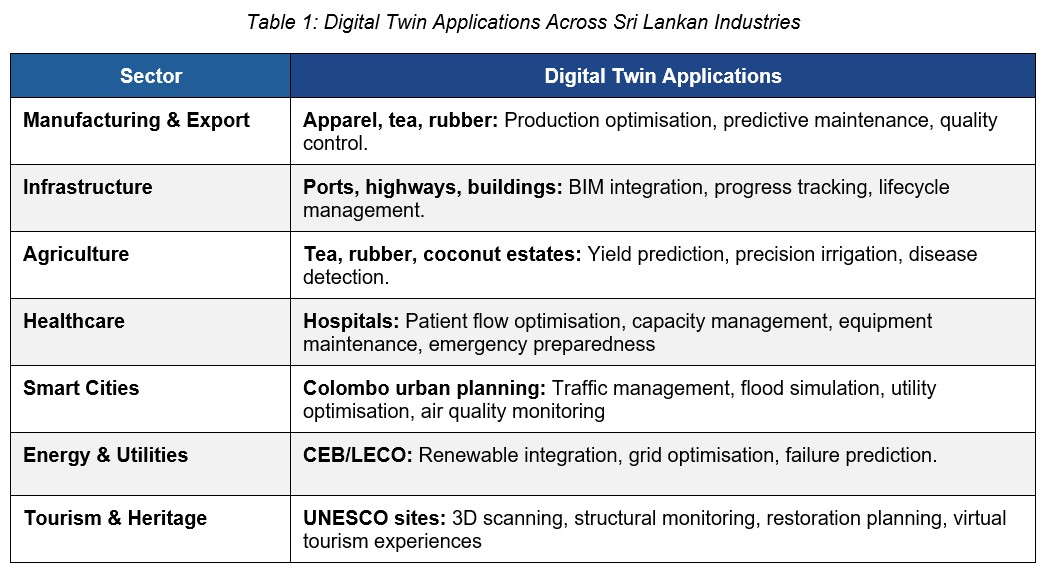
Digital Twin technology offers significant potential across Sri Lanka's diverse economic landscape, including manufacturing and export industries, infrastructure development for ports and transportation networks, precision agriculture for plantation crops, healthcare facility management, smart city initiatives in urban centres, energy sector optimisation, and cultural heritage preservation. Table 1 outlines the specific digital twin applications across these key sectors, demonstrating how this technology can address industry-specific challenges while supporting Sri Lanka's broader economic development and sustainability goals.
Benefits and Limitations for Sri Lanka
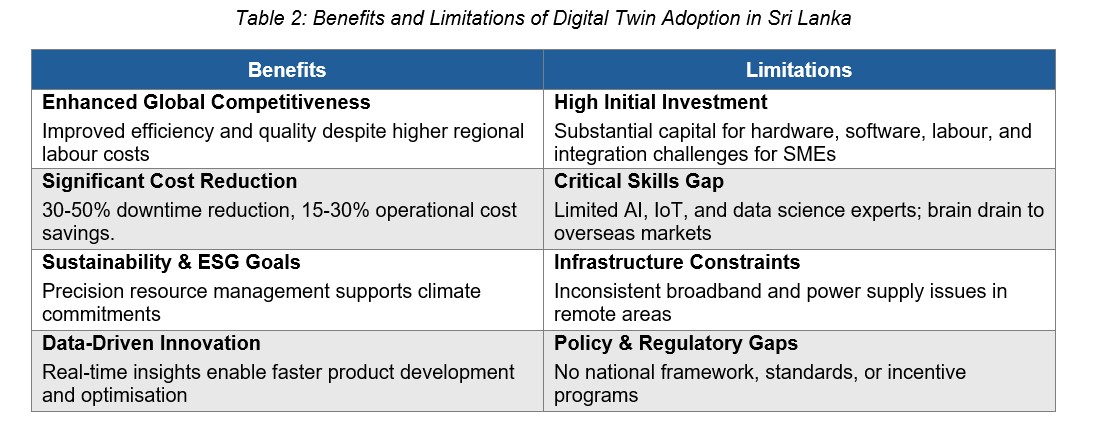
While Digital Twin technology presents substantial opportunities for Sri Lanka, its adoption faces both enabling factors and significant challenges. The benefits include enhanced global competitiveness through improved operational efficiency, significant cost reductions in maintenance and operations, support for sustainability and Environmental, Social, and Governance (ESG) commitments, and data-driven innovation capabilities. However, several limitations must be addressed for successful implementation. These include the high initial investment requirements that may be prohibitive for small and medium enterprises (SMEs), a critical skills gap in AI, IoT, and data science expertise with ongoing brain drain concerns, infrastructure constraints related to inconsistent broadband and power supply, and the absence of a national framework or regulatory standards to guide adoption. Table 2 summarises these key benefits and limitations, highlighting the need for strategic planning and policy support to realise the full potential of digital twin technology in Sri Lanka.
Recommended Roadmap
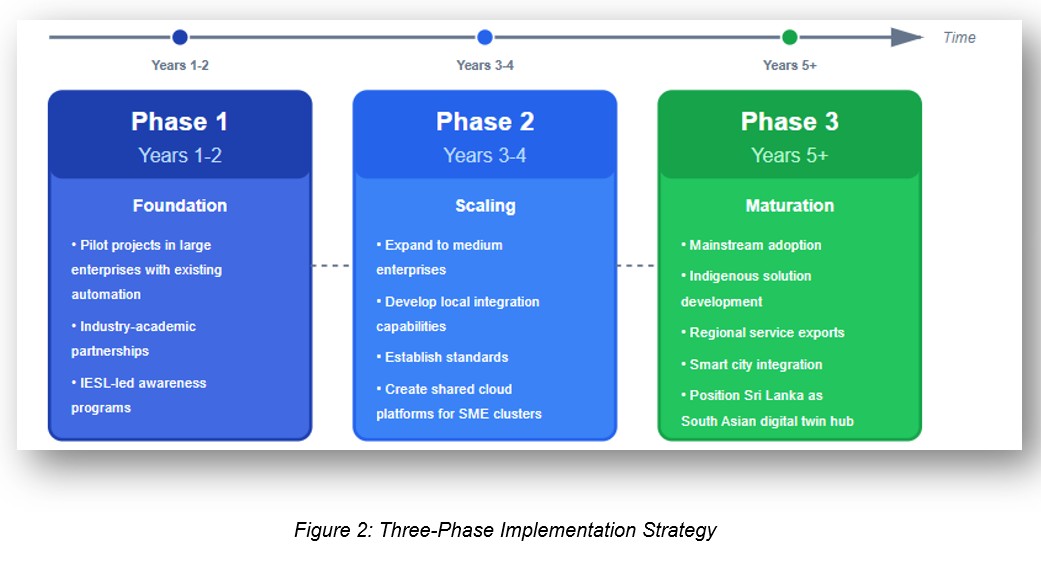
Successful digital twin adoption in Sri Lanka requires a strategic three-phase approach spanning 5+ years, as shown in Figure 2. Beginning with focused pilots in established sectors, the roadmap progressively builds local capabilities, develops supporting infrastructure, and establishes policy frameworks. This phased strategy minimises risk while maximising learning, ultimately positioning Sri Lanka as both a consumer and developer of digital twin solutions for regional markets, leveraging our unique strengths in ICT services and domain expertise.
Conclusion
Digital twin technology offers Sri Lankan industries a powerful pathway to enhance global competitiveness through data-driven optimisation, predictive capabilities, and virtual innovation. While challenges of cost, skills, and infrastructure are significant, they are not insurmountable. Success requires a strategic, phased approach, starting with high-impact pilots, leveraging cloud platforms to democratize access, and building local expertise through collaborative efforts. The Institution of Engineers, Sri Lanka, plays a vital role in facilitating this transformation through knowledge sharing, professional development, and policy advocacy. The question is not whether to adopt digital twin technology, but how strategically and rapidly Sri Lanka can position itself as both a consumer and developer of these solutions for regional markets.
References
[1] Straits Research, “Digital Twin Market Size & Outlook, 2025-2033,” 2025. [Online]. Available: https://straitsresearch.com/report/digital-twin-market.
[2] HyScaler, “Introduction to Digital Twin Technology in Manufacturing with Unprecedented Efficiency and Innovation,” Aug. 2024. [Online]. Available: https://hyscaler.com/insights/digital-twin-technology-manufacturing.
[3] IoT Funda, “Digital Twins: Revolutionizing the Connection Between Physical and Digital Realms,” Mar. 2025. [Online]. Available: https://iotfunda.com/digital-twins-bridging-physical-digital-worlds.
[4] MarketsandMarkets, “Digital Twin Market by Deployment, Application, Industry and Region - Global Forecast to 2030,” 2025. [Online]. Available: https://www.marketsandmarkets.com/Market-Reports/digital-twin-market-225269522.html.
[5] IMARC Group, “Digital Twin Market Size, Growth, Analysis & Forecast [2033],” 2024. [Online]. Available: https://www.imarcgroup.com/digital-twin-market.
 Dr. Kasun Subasinghage is a Senior Lecturer in the Department of Materials and Mechanical Technology at the Faculty of Technology, University of Sri Jayewardenepura, specialising in Mechatronics. He earned his Ph.D. from Auckland University of Technology, New Zealand, in 2019, following his M.Sc. and B.Sc. (Hons) in Electrical Engineering from the University of Moratuwa, Sri Lanka. His research focuses on the design and implementation of smart systems, supercapacitor-assisted systems and wireless communication technologies for industrial and applied mechatronic applications.